
Clinical Services
Every clinical service at The Liver Institute, Rajagiri Hospital is designed around coordinated, evidence-based care—ensuring patients and their families have seamless access to routine, urgent, and highly specialized liver treatments under one roof.

Outpatient Hepatology (Monday through Saturday)
Our Daily Outpatient Hepatology service provides accessible, structured care for the full spectrum of acute and chronic liver conditions—including fatty liver disease, viral and autoimmune hepatitis, alcohol-related liver disease, cirrhosis, cancerous and non-cancerous liver tumours, rare liver diseases such as primary sclerosing cholangitis, primary biliary cholangitis and drug- or herb-induced liver injury. Patients benefit from thorough diagnostic evaluations, rational and logical second opinions, and personalized treatment plans that prioritize proven therapies while avoiding unnecessary tests or medications.

24 x 7 Emergency Hepatology
Liver emergencies can escalate rapidly and demand immediate specialist judgment. Our 24 x 7 Emergency Hepatology service ensures that patients experiencing sudden jaundice, acute liver failure, acute-on-chronic liver failure, severe abdominal fluid buildup (ascites), liver-related brain failure (hepatic encephalopathy), or life-threatening infections are evaluated without delay by experienced hepatologists and supported by round-the-clock critical care, endoscopy, and radiology teams.
Dedicated Critically Ill Cirrhosis Unit
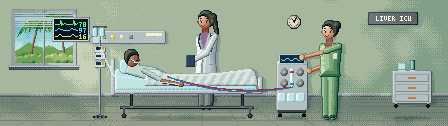
Designed specifically for the sickest liver patients, our Dedicated Critically Ill Cirrhosis Unit combines specialized Liver Intensive Care Units (Liver ICUs) and Liver High Dependency Units (HDUs) with aggressive, life-saving organ-support therapies. Staffed around the clock by hepatologists, transplant anaesthetists, and critical care nurses, the unit delivers advanced interventions—including therapeutic plasma exchange (PLEX), sustained low-efficiency dialysis (SLED), and continuous renal replacement therapy (CRRT)—to stabilize multi-organ failure, manage severe infections, and bridge critically ill patients toward recovery or liver transplantation.

Round the Clock Bleeding in Cirrhosis Management Unit
Gastrointestinal bleeding from enlarged veins (varices) in the food pipe or stomach is one of the most urgent complications of cirrhosis. Our dedicated Bleeding in Cirrhosis Management Unit provides immediate stabilization, emergency therapeutic endoscopy, and seamless 24/7 backup from Interventional Hepatobiliary Radiology—allowing rapid escalation to life-saving interventional radiology minimally invasive vascular procedures such as salvage TIPS (liver stenting), PARTO (bleeding source occlusion), or percutaneous variceal embolization (managing internal bleeding from the outside) whenever bleeding is difficult to control by standard methods.

Interventional Hepatology
Backed by high-end ultrasound and Doppler, 128-slice CT, 3T MRI, and an ultra-modern bi-plane catheterization laboratory, our Interventional Hepatology (Interventional Hepatobiliary Radiology) unit performs among the highest volumes of specialized liver interventions in the country. Through minimally invasive, image-guided procedures, our experts perform liver pressure [hepatic venous pressure gradient (HVPG)] measurement, specialized biopsy techniques that do not cause bleeding such as transjugular liver biopsy (TJLB), transjugular and direct intrahepatic portosystemic shunts (TIPS and DIPS) – for controlling fluid in abdomen and chest and repeated or severe bleeding complications in liver disease, TIPS-related portal vein recanalization (opening up of the main vein of the liver when it is blocked), plug-assisted retrograde transvenous obliteration (PARTO) and shunt occlusion for recurrent bleeding or repeated or persistent severe brain failure in cirrhosis, percutaneous variceal embolization, percutaneous transhepatic biliary drainage (PTBD) – for bile obstruction and tumours in the liver; and stenting, endobiliary radiofrequency ablation – for malignant tumours in the liver, partial splenic artery embolization – to improve platelet count and treat large spleens, and targeted liver cancer therapies including super-ultraselective TACE, radiofrequency ablation (RFA), and microwave ablation.

Liver Transplantation Unit for Children and Adults
Our Liver Transplantation Unit offers comprehensive living-donor and deceased-donor liver transplantation for both adults and children, supported by dedicated liver transplant operation theatres and separate Intensive Care Units for donors and recipients. A multidisciplinary team of GI/HPB and multi-organ transplant surgeons, transplant hepatologists, transplant anaesthetists, interventional radiologists, nurses, and coordinators guides families through every step—from evaluation and legal compliance to minimally invasive laparoscopic and robotic (Da Vinci Xi) donor surgery—ensuring safety, precision, and compassionate support.

Post Liver Transplant Lifelong Care Unit
A successful liver transplant is the beginning of a new chapter, and long-term health depends on consistent, specialized follow-up. Our Post Liver Transplant Lifelong Care Unit partners with recipients and their families for years after surgery—carefully fine-tuning anti-rejection medications, monitoring graft function, preventing infections and metabolic complications, and providing practical lifestyle and nutrition guidance so transplant recipients can return to full, active, and healthy lives.

Special Gastroenterology Clinic for Liver Patients
Patients with liver disease frequently face complex digestive, biliary, and pancreatic problems that require specialized endoscopic expertise. Our Special Gastroenterology Clinic for Liver Patients houses state-of-the-art video endoscopy suites offering Endoscopic Ultrasound (EUS), Endoscopic Retrograde Cholangiopancreatography (ERCP), upper and lower GI endoscopy, colonoscopy, and advanced biliary or luminal stenting as well as highly advanced third-space endoscopy procedures—enabling precise diagnosis and minimally invasive treatment of bile duct blockages, stones, and digestive complications, often helping patients avoid open surgery altogether.

Special GastroSurgery Unit for Liver Patients
Performing non-liver abdominal, colorectal, biliary, or pancreatic surgery in a patient with cirrhosis or portal hypertension carries significantly higher risk and requires extraordinary surgical and medical coordination. Our Special GastroSurgery Unit for Liver Patients brings together expert GI and HPB surgeons, hepatologists, and transplant anaesthetists—utilizing advanced laparoscopic techniques and the latest Da Vinci Xi Robotic Surgical System—to safely perform complex, high-risk non-liver surgeries with minimal trauma, meticulous perioperative liver protection, and top-level clinical expertise.